The Rise of the 0 Percent Unicorn: Why Seasoned B2B Executives Are Choosing Mature, Steady Companies Over Hyper-Growth Startups

The landscape of executive career paths within the technology and business-to-business (B2B) sectors is experiencing a subtle yet profound structural shift. While the allure of early-stage, hyper-growth artificial intelligence startups has dominated the talent market for the better part of the decade, a growing segment of seasoned executives is opting for a radically different destination: mature unicorn and centicorn companies experiencing annualized growth rates hovering between zero and ten percent.
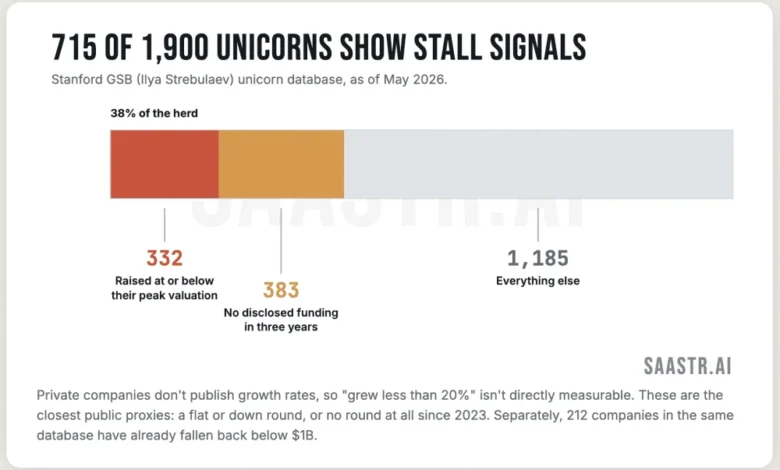
To understand this phenomenon, one must examine the current state of the global startup ecosystem. According to market trackers such as Hurun’s 2026 index, CB Insights, and Eqvista, the global count of private companies valued at $1 billion or more—commonly known as unicorns—currently spans between 1,400 and 1,700 entities. A substantial portion of these enterprises achieved their unicorn status during the venture capital boom of 2021 and 2022. In the years since, market corrections, normalized macroeconomic conditions, and tightening capital markets have transitioned many of these once-meteoric organizations into a steady, flat-lining operational cadence.
These firms are no longer doubling or tripling their annual recurring revenue (ARR) year-over-year. Instead, they are growing at 0% to 10%. Crucially, however, they are also not shrinking. Many have successfully reengineered their cost structures over the preceding two years, achieving cash flow break-even status or positive operational margins. Yet, despite their plateaued growth trajectories, these legacy unicorns still require robust leadership teams—including Chief Revenue Officers (CROs), Chief Marketing Officers (CMOs), Vice Presidents of Customer Success, and Heads of Product—to maintain their vast operations.
The Economics of Maintaining Flat Growth
For outsiders, a company growing at 0% might imply organizational stagnation or a lack of ambition. Industry veterans, however, recognize that maintaining a flat revenue line in a mature market requires rigorous, continuous effort, particularly when accounting for natural customer churn, downgrades, seat contractions, and macroeconomic pressures.
Consider a mature B2B enterprise generating $150 million in ARR with a healthy, industry-standard gross revenue retention rate of 88%. Such a company faces approximately $18 million in revenue walking out the door annually due to client churn, corporate mergers, executive turnover, or changing product needs. To achieve a net growth rate of 0%, the executive leadership and go-to-market teams must successfully close $18 million in new and expansion ARR every single year.
Assuming an average enterprise deal size of $150,000, this objective requires securing roughly 120 new client logos annually alongside a comprehensive expansion motion. Operationally, this demands a sales organization comprising 30 to 50 quota-carrying representatives, a fully functioning marketing funnel, a specialized systems engineering team, a customer success division dedicated to renewals and upsells, and a product organization capable of continuously shipping updates to mitigate churn risk. Consequently, steering a flat enterprise is far from a passive assignment; it demands traditional, highly disciplined management execution.
The Appeal of the Pre-AI Playbook
One of the most compelling factors drawing veteran leaders to flat-growth companies is the continued relevance of traditional operational playbooks. At AI-native startups experiencing hyper-growth rates of 300% to 1,000% or more, operational models established between 2012 and 2022 are frequently challenged, reevaluated, or entirely discarded on a weekly basis. Questions regarding the viability of traditional sales development representative (SDR) models, optimal pricing structures, human versus automated demonstrations, and product-led versus agent-led go-to-market strategies create an environment of relentless structural reinvention.
Conversely, at a $150 million ARR company growing at modest single-digit rates, leadership challenges are largely anchored in classical operational rigor. Executives are tasked with territory design, pipeline coverage ratio optimization, rigorous win/loss analysis, professionalization of enablement functions, and pricing refinements designed to capture incremental expansion points. Fixing onboarding gaps that trigger late-stage churn or tightening ideal customer profiles (ICPs) to eliminate non-renewing accounts are challenges that a seasoned executive with fifteen years of enterprise experience can address effectively from day one. This allows leaders to apply established expertise without perpetually relearning their professional discipline in an unpredictable market.

Compensation and Quality of Life Considerations
Beyond operational familiarity, compensation structures play a pivotal role in executive decision-making. Early-stage AI startups experiencing rapid growth frequently offer modest cash compensation augmented by high-risk equity packages, coupled with demanding workplace cultures—often colloquially referred to as the "996" schedule (working from 9:00 AM to 9:00 PM, six days a week).
In contrast, mature companies with revenues ranging from $150 million to over $500 million possess substantial cash reserves, particularly after undertaking significant cost-rationalization measures. These organizations are positioned to offer competitive cash salaries, particularly for Vice President-level roles and above, alongside stable operational budgets, established customer reference bases, and recognized brand equity. For executives entering these roles, the mandate is often incremental optimization—such as elevating growth from 6% to 11%—rather than existential survival or hyper-scaling.
This structural stability aligns closely with shifting demographic and lifestyle priorities among senior corporate leaders. After a decade of navigating the volatility of early-stage ventures, many executives prioritize sustainable work-life integration, family commitments, and predictable schedules over the intense pressure of around-the-clock startup environments. For those less inclined to navigate the radical technological and operational shifts of the generative AI era, joining a steady, mid-to-large-scale enterprise offers a rational, high-value utilization of their core competencies.
Strategic Risks and Due Diligence
Despite the evident stability, market analysts caution that executive recruitment within flat-growth companies requires rigorous due diligence. A company operating at 0% growth is often only one poor quarter away from a negative trajectory. A transition into a declining enterprise ("down-growth") presents an entirely different professional mandate characterized by corporate restructurings, workforce reductions, private equity intervention, and protracted asset evaluations.
Therefore, prospective candidates must carefully evaluate corporate fundamentals during the interview process. Experts recommend ensuring that base compensation remains highly competitive, equity grants are tied to realistic, achievable acceleration milestones, and executive alignment regarding core business metrics is established prior to contract execution.
Implications for the Broader Executive Talent Market
The mainstream emergence of the "0% unicorn" executive option signals a maturing technology sector. As venture capital funding constraints have slowed the pace at which new hyper-growth giants are minted, the executive talent pool is dividing into two distinct philosophies: those who thrive in the high-velocity, high-risk world of next-generation technologies, and those who prefer the methodical, predictable execution required to steward established market players.
As more mid-stage startups mature into this holding pattern, the market for stable executive leadership is expected to expand further. For corporations seeking steady guidance through complex economic environments, hiring leaders who specialize in preservation, optimization, and methodical execution may well become the defining operational strategy of the post-boom technology era.